

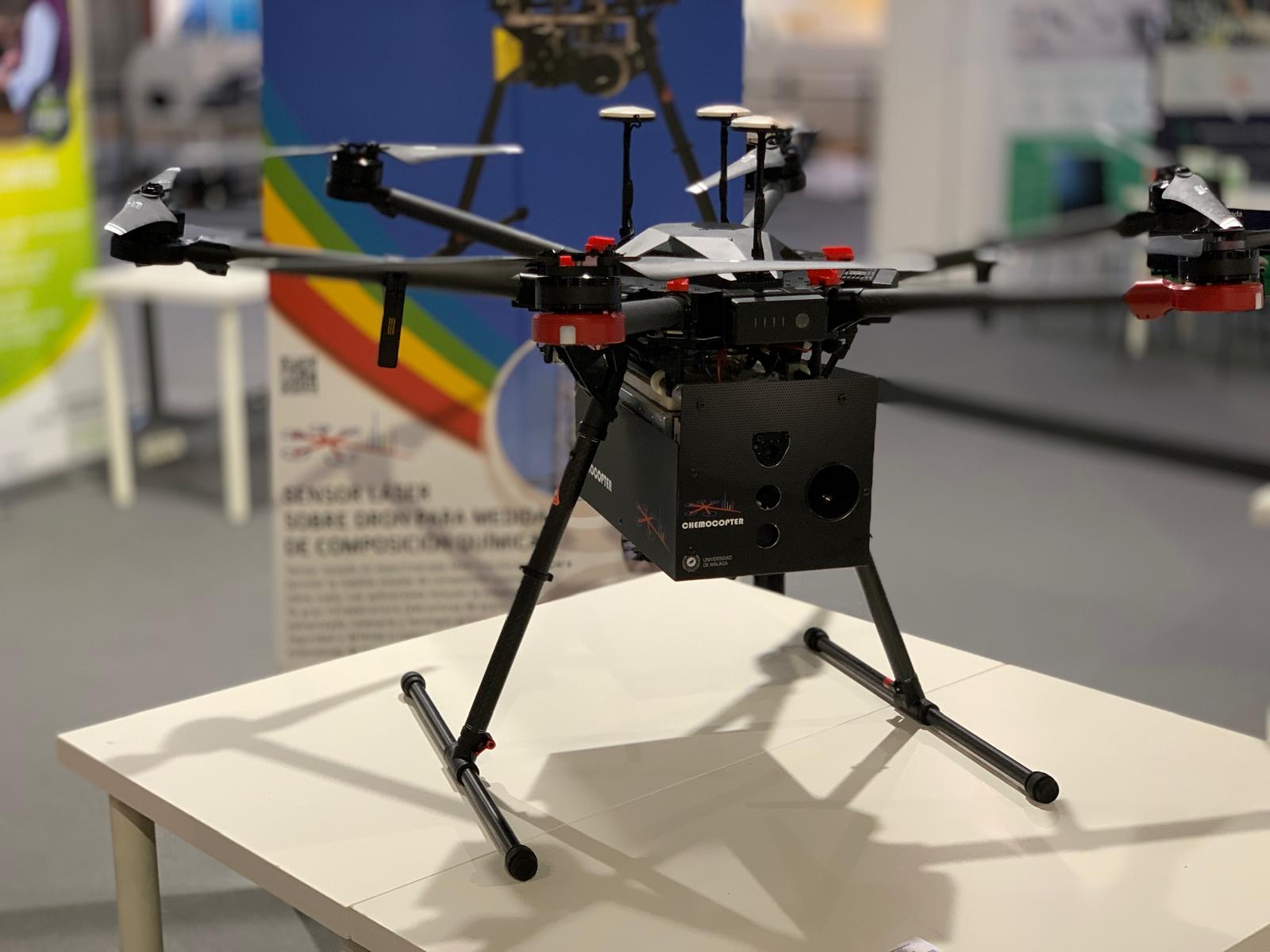
Sixth-generation airborne laser-based instrumentation for airborne remote material analysis

The first fully integrated airborne laser-induced breakdown spectrometer worldwide, and the foundation of a consolidated body of technologies and know-how enabling the rapid development of dedicated field instruments. Through successive generations, Chemocopter established key capabilities in autonomy, robustness, signal stabilization, geo-referencing and time-stamped data acquisition, later reused across multiple projects.


Laboratory test bed and 1st, 4th, and 6th generation Chemocopter instruments (some details have been altered or removed).
Instrumentation approach
Chemocopter is a compact airborne laser-based analytical instrument developed through multiple generations of iterative design. The current system integrates:
- High-performance signal stabilization exceeding the capabilities of commercial stabilizers
- Continuous autofocus operation over stand-off distances ranging 2 m to 10 m
- Real-time laser safety control fully independent of the onboard computer
- Seamless autonomous or remotely supervised operation
- Geo-referenced and time-stamped data acquisition
- Chemical terrain mapping capabilities (in combination with UAV software)
Instrument control and development philosophy
All subsystems — optics, mechanics, electronics, embedded control and software — are designed and integrated in-house. This provides full control over instrument behavior for each specific application and enables rapid iteration and quick turn-around development cycles.
Performance and maturity
Despite its compact size and low weight (approximately 3.5 kg, including housing), Chemocopter delivers analytical figures of merit comparable to laboratory-based LIBS systems while operating in flight and at stand-off distances from the target. This performance is achieved through a unique optical design optimized for two-way optical throughput and an advanced signal stabilization technique, both systematically refined and improved across successive generations of the instrument.
Status
Ongoing development / multiple generations completed.