

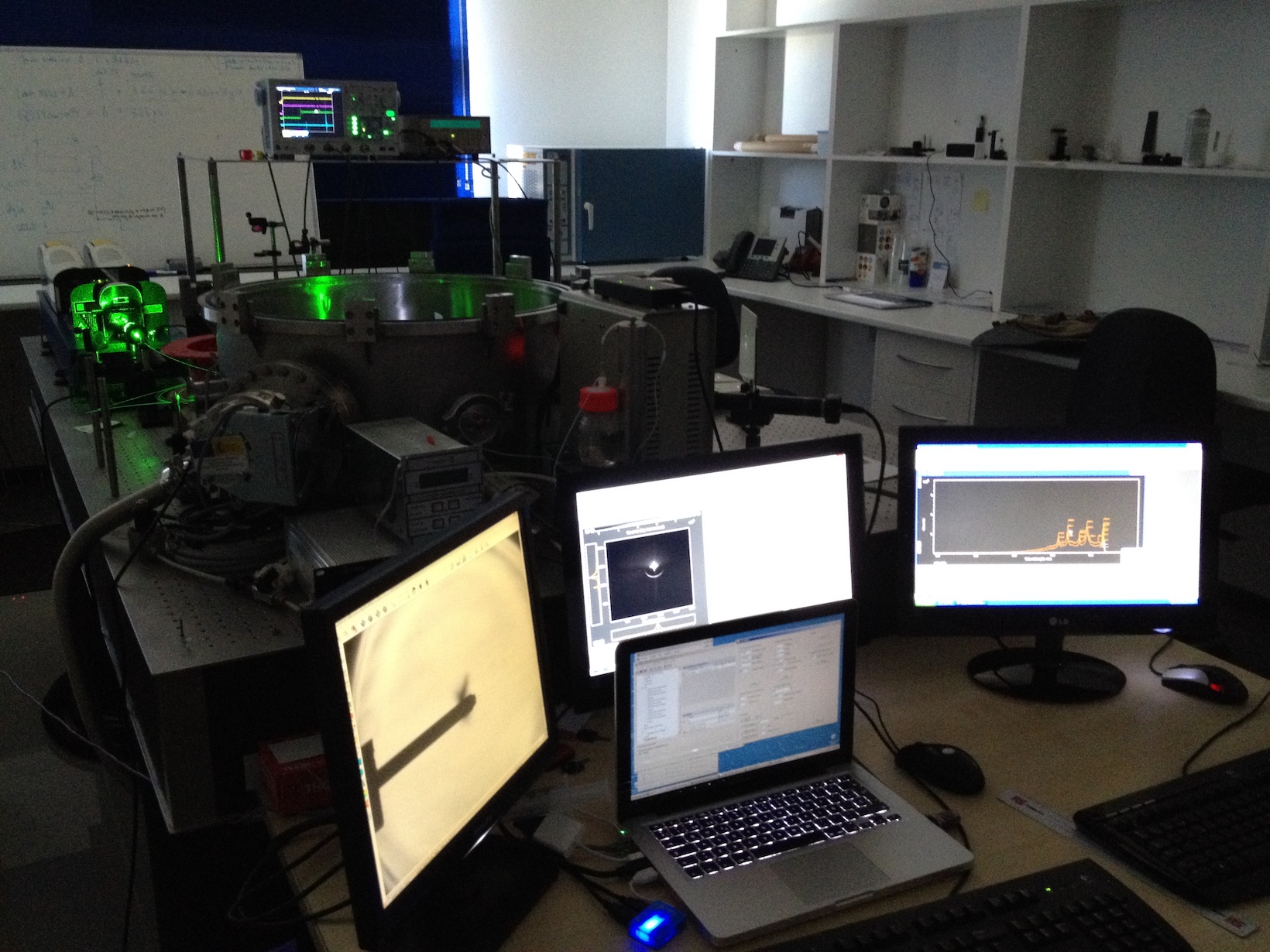
A significant part of the group’s activity is rooted in fundamental research on laser–matter interaction and plasma-related phenomena, which provides the scientific basis for many of its applied developments in extreme instrumentation. This research encompasses the study of laser-induced plasmas, energy coupling mechanisms and transient processes occurring during pulsed laser irradiation of materials.


A distinctive and pioneering line within this framework is the acoustic spectroscopy of laser-induced shockwaves, introduced and developed by Santiago Palanco more than two decades ago. By exploiting spectral and temporal features of the shockwave generated during plasma expansion, this approach enables the diagnosis and understanding of plasma formation and dynamics, which are in turn conditioned by the physical and chemical properties of the irradiated sample. This approach established shockwave-based diagnostics as a complementary sensing modality and has remained a latent yet recurring thread across successive research efforts within the group, continuing to evolve and inform current developments in advanced sensing and data fusion.
In parallel, the group has developed fundamental expertise in laser-enabled material processing and diagnostics, including laser ignition and characterization of energetic materials, pulsed laser deposition (PLD) under controlled plasma and shockwave conditions, and plasma-assisted laser nanopatterning concepts. These studies link controlled laboratory investigations with the design of robust sensing strategies and contribute to the scientific understanding that underpins our current efforts in field-deployable instrumentation, multi-sensor sensing and advanced data analysis.

